
From Single Axis to 4-Axis Gantry: A Beginner’s Guide to Multi-Axis Linear Actuators
2025-12-04Electric Grippers 101: How to Upgrade from Pneumatic Fingers to Smart Clamping
2025-12-081. What Is a Pneumatic Cylinder?
A pneumatic cylinder converts compressed air energy into linear motion.
Basic characteristics:
- Compressed air pushes on a piston inside a tube.
- The piston rod moves in and out, guided by seals and bearings.
- Flow control valves set speed; end cushions reduce impact.
- Positions are usually just “extend” and “retract”, with limited control in between.
Why they are popular:
- Simple and rugged structure
- Low initial hardware cost
- Easy to understand and maintain
- Works well for on/off tasks such as clamping, ejecting, or indexing
Limitations:
- Position control is coarse
- Speed and force vary with air pressure and load
- Compressed air is often expensive to generate and can leak over time
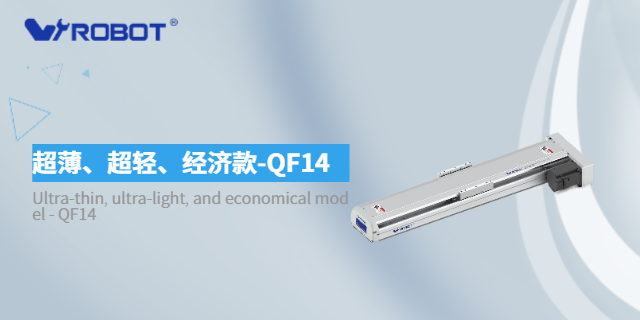
Ultra-thin, ultra-light, and economical mod
2. What Is an Electric Cylinder?
An electric cylinder looks similar from the outside: a tubular body with a moving rod. Inside, however, it uses electromechanical transmission instead of compressed air.
Typical structure:
- A servo motor or stepper motor drives a ball screw or roller screw.
- The screw converts rotary motion into linear motion of the rod.
- A servo drive controls speed, position, and torque.
- A closed-loop electric cylinder uses feedback (encoder) to monitor position and load.
Key advantages:
- Precise, programmable position control
- Adjustable speed and acceleration profiles
- Force control and soft landing possibilities
- No compressed air infrastructure needed
Trade-offs:
- Higher initial hardware and integration cost
- Requires electrical noise management, drive tuning, and proper sizing
- Sensitive to overload if not protected by software and mechanical limits
3. Motion Control: Discrete vs Fully Programmable
3.1 Pneumatic cylinders – simple but limited
Pneumatic cylinders are essentially two-position devices:
- Fully extended
- Fully retracted
Intermediate positions are possible with special valves and mechanical stops, but they are not very precise. Speed is controlled by throttling air flow, so it can drift with:
- Supply pressure changes
- Temperature
- Wear and leakage
For applications like pushing parts off a conveyor or opening a gate, this simplicity is acceptable. For more complex motion profiles, it becomes a constraint.
3.2 Electric cylinders – servo-like motion in a cylinder format
A servo-driven electric cylinder behaves mechanically like a cylinder but functionally like a linear servo axis:
- Any position within the stroke can be targeted.
- Motion profiles (speed, acceleration, jerk) are programmable.
- Closed-loop control maintains accuracy despite load variations.
- Multiple positions and recipes can be stored in the controller.
This opens up possibilities:
- Multi-position stops instead of just in/out
- Synchronized motion with other axes
- Soft approach and controlled force on contact
- Adaptive motion based on sensor feedback
If your process needs repeatable positioning, smooth motion or flexible adjustment, an electric cylinder is usually the better tool.
4. Force, Speed, and Performance
4.1 Force capability
Pneumatic cylinders:
- Force is approximately
Pressure × Piston area. - Higher pressure or larger bore increases force.
- Force drops if air pressure fluctuates or if friction increases.
Electric cylinders:
- Force is determined by motor torque, screw lead, and mechanical efficiency.
- A servo cylinder can deliver high peak force for short periods and stable continuous force when sized correctly.
- Closed-loop control allows precise force limiting and detection of abnormal conditions.
For very high peak forces over short strokes, air cylinders can still be attractive. When you need controlled and repeatable force, especially during pressing or joining operations, an electric cylinder offers more control.
4.2 Speed and duty cycle
Pneumatic cylinders can move very quickly, especially over short strokes, but:
- Speed control is less precise.
- High-speed impacts can generate noise and wear.
- Continuous high-frequency cycling increases maintenance.
Electric cylinders can also reach impressive speeds, depending on screw lead and motor power, and they offer:
- Precise deceleration before reaching the end position
- Reduced impact and vibration
- Well-defined duty cycle limits based on motor and screw ratings
For high-speed positioning with repeatable stop accuracy, electric solutions usually perform more consistently.
5. Cost: Hardware vs Total Cost of Ownership
When people compare electric cylinder vs pneumatic cylinder, cost is often the first concern.
5.1 Initial hardware cost
- A basic pneumatic cylinder, valves, and fittings generally have lower purchase cost than an electric cylinder with servo motor and drive.
- For very simple on/off motions, this difference can be significant.
5.2 Operating and energy cost
However, compressed air is not free:
- Compressors consume a lot of electrical energy.
- Leaks are common and sometimes unnoticed.
- Complex air systems require dryers, filters, and maintenance.
Electric cylinders use electricity more directly:
- Only the servo motor and drive consume power.
- There is no continuous energy loss from leakage.
- Regenerative braking can return energy in some cases.
Over the life of the machine, especially in 24/7 production, the total cost of ownership of electric cylinders can be competitive or even lower, particularly when you also consider:
- Reduced scrap from better motion control
- Less downtime for seal replacement or leakage troubleshooting
- Fewer quality issues tied to air-pressure fluctuations
6. Flexibility and Changeover
Modern production lines must adapt quickly to new products and variants.
Pneumatic cylinders:
- Changing stroke or position typically requires mechanical adjustments, new end stops, or replacing components.
- Pressure regulators and flow controls may need manual tweaking for each product.
Electric cylinders:
- Stroke, speed, and force can be adjusted in the control program.
- Different “recipes” can be selected by the PLC or operator panel.
- This makes format change and product changeover faster and more repeatable.
If your line is built for many product variants, this flexibility can save significant engineering and changeover time.
7. Safety and Diagnostics
Electric and pneumatic solutions handle safety differently.
Pneumatic cylinders:
- Fail-safe designs often rely on spring-return cylinders, pressure relief, or mechanical locks.
- It can be harder to know the exact position or force without additional sensors.
Electric cylinders:
- With a servo cylinder and encoder, you always know the commanded and actual position.
- Faults such as overload, motor error, or following error are detected by the drive.
- Safety-rated drives and brakes can support functional safety concepts (e.g., safe torque off).
For applications where traceability, diagnostics, and advanced safety functions are important, electric cylinders naturally fit into the control architecture.
8. When to Choose Pneumatic Cylinders
Pneumatic cylinders remain a solid choice when:
- Motion is simple on/off with just two positions.
- Accuracy requirements are loose, and small variations are acceptable.
- The plant already has a large compressed air infrastructure.
- The axis operates relatively infrequently, so energy losses are small.
- Budget constraints are strict and there is no need for future flexibility.
Typical examples:
- Basic clamping, ejecting, and locking mechanisms
- Simple indexing where position tolerance is generous
- Low-duty-cycle mechanisms in support equipment
9. When to Choose Electric Cylinders
A closed-loop electric cylinder or servo cylinder makes sense when:
- You need precise and repeatable position control, not just in/out.
- Several positions and motion profiles are required in the same axis.
- Force control matters, for example in press-fit, sealing, or tensioning processes.
- The axis runs frequently and energy efficiency is a concern.
- You want fast changeover by changing parameters, not mechanics.
- Diagnostics and integration into a central motion control system are important.
Typical applications:
- Format adjustment axes in packaging machines
- Press-fitting, clinching, and controlled tightening
- Handling and assembly in electronics and automotive manufacturing
- Lab automation or medical device assembly where consistency is critical
10. Summary
The choice between electric cylinders vs pneumatic cylinders is not about one technology replacing the other everywhere. It is about using each where it makes the most sense:
- Pneumatic cylinders excel in simple, rugged, on/off tasks with low accuracy requirements and short duty cycles. Their hardware cost is low and they leverage existing air systems.
- Electric cylinders, especially closed-loop electric cylinders driven by servo technology, provide precise motion control, flexible programming, and more efficient energy usage in continuous or complex applications.
