
Electric Cylinders vs Pneumatic Cylinders: Motion Control, Force and Cost
2025-12-05Desktop Motion Platforms for Lab Automation: Turn One XYZ Stage into a Mini Factory on Your Bench
2025-12-091. What Exactly Is an Electric Gripper?
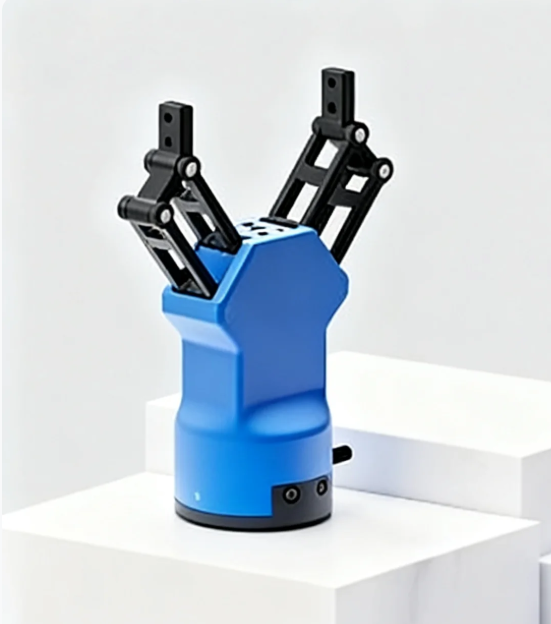
An electric gripper is a robot gripper driven by an electric motor instead of compressed air. Inside the housing you will typically find:
- A small servo motor or stepper motor
- A transmission (ball screw, rack, cam or wedge) that converts rotation into finger motion
- A pair of fingers (or more) that open and close
- Electronics that handle power, control and feedback
From the outside, an electric gripper looks similar to a pneumatic one, but functionally it behaves like a small servo axis:
- You can set an exact opening width
- You can control speed and acceleration
- You can limit gripping force
- You can often read back position and status signals
This is why people also call it a servo gripper.
2. Why Upgrade from Pneumatic Fingers?
Pneumatic grippers still work well for very simple pick-and-place tasks. But they start to struggle in four typical situations.
2.1 More product variants
With an air gripper, jaw stroke and stops are set mechanically. If your line handles several product sizes, operators must:
- Change mechanical stoppers
- Adjust pressure and flow valves
This costs time and introduces variation. Electric grippers store multiple recipes in the controller. One collaborative robot gripper can handle a full product family just by switching parameters.
2.2 Fragile or soft parts
Glass lenses, plastic housings, cosmetic packaging, battery cells or food products can be damaged easily. Air pressure is not very precise; a tiny change in pressure can mean a big change in force at the jaws.
Electric grippers allow you to:
- Define a maximum force
- Use “fast approach + soft close”
- Detect contact and stop before deforming the part
This is hard to achieve with pneumatic fingers.
2.3 Need for process data
Many factories now want to log what happens at every station. With air grippers you usually only know:
- “Valve on”
- “Valve off”
There is little information about whether the part was actually gripped correctly.
Electric grippers can report:
- Target and actual position
- Whether a part is present
- Overload or collision events
This makes it easier to trace quality issues and do predictive maintenance.
2.4 Robots working with people
In collaborative robot cells, safety standards require controlled limiting of force and speed. Having a collaborative robot gripper with adjustable force is a major advantage. It helps avoid pinch injuries and protects both operators and hardware.
3. Main Types of Electric Grippers
There are several mechanical styles; the most common are:
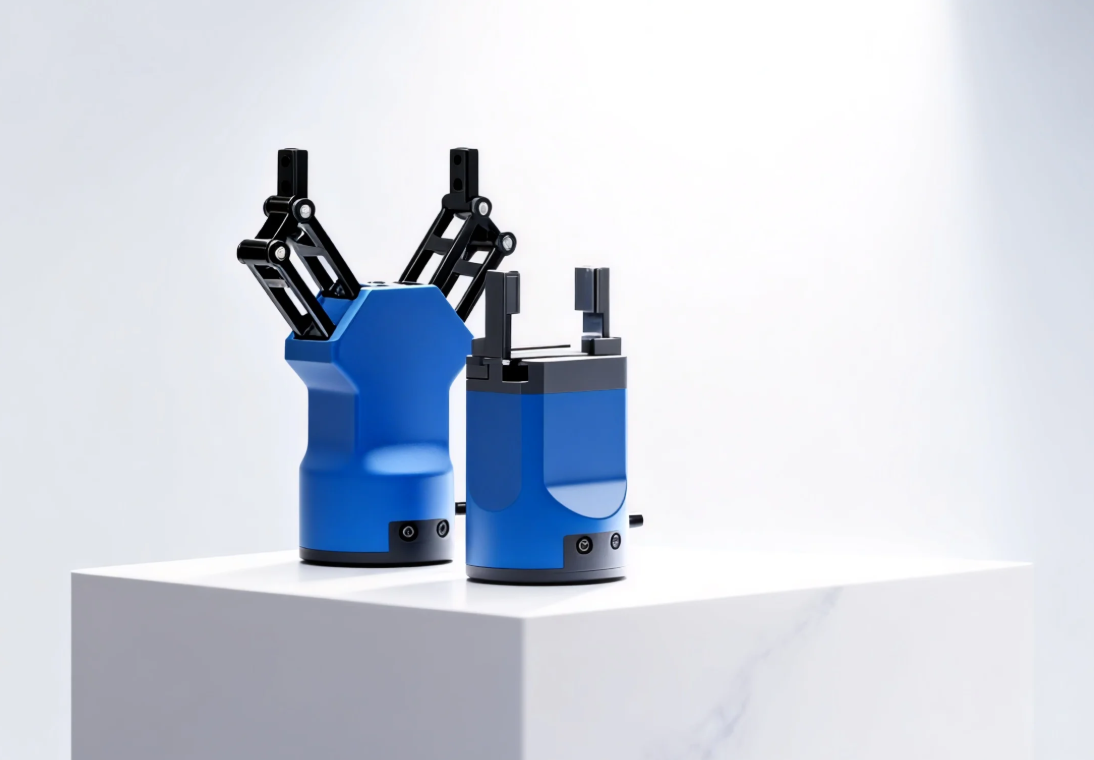
3.1 Parallel servo gripper
- Fingers move in parallel, closing towards the centre
- Good for most prismatic parts, boxes, and small components
- Easy to design custom fingertips for different shapes
3.2 Angular servo gripper
- Fingers rotate around a pivot point
- Useful when you need a larger opening angle in a compact body
- Often used for removing parts from tight fixtures
3.3 Three-jaw or centric gripper
- Three fingers closing radially towards the centre
- Ideal for round parts such as shafts, bushings or cylindrical cells
Each style can be implemented as a compact robot gripper for industrial arms or as a module mounted on a linear module or desktop platform.
4. Electric Gripper vs Pneumatic Gripper
4.1 Position and stroke control
- Pneumatic: usually two positions (open / close). Any intermediate position requires extra hardware and is not very repeatable.
- Electric: any position within the stroke can be commanded. One gripper can handle multiple part widths without mechanical changes.
4.2 Force control
- Pneumatic: force depends on air pressure and friction; fine tuning is difficult.
- Electric: force can be limited and monitored in software. Some servo grippers offer dedicated force control modes.
4.3 Speed and motion profile
- Pneumatic: very fast, but motion is hard to shape; fingers often hit hard stops.
- Electric: you can define fast approach, slow final closing, and soft landing. This reduces impact and vibration.
4.4 Energy and infrastructure
- Pneumatic: needs compressors, dryers, filters, tubing and valves. Leaks are common.
- Electric: needs only power and communication cables. No compressed air network is required.
4.5 Maintenance and downtime
- Pneumatic: seals and valves wear, leaks are sometimes difficult to find.
- Electric: moving components still wear, but diagnostics are easier—overcurrent, position error or temperature alarms tell you what is wrong.
In short: the air gripper is simple and cheap for basic jobs; the electric gripper is a flexible, controllable tool for more demanding tasks.
5. How to Choose an Electric Gripper
When selecting an electric gripper for your robot or linear module, walk through these steps.
5.1 Define the gripping tasks
- Part dimensions (min and max width, height, thickness)
- Weight and surface (smooth, rough, oily, delicate)
- Required orientation (top pick, side pick)
- Required cycle time and duty cycle
5.2 Mechanical sizing
- Stroke: choose a gripper that covers the full range, with some margin.
- Payload: include workpiece, fingertips and any additional tools.
- Finger length: longer fingers increase torque on the jaws; check the manufacturer’s moment ratings.
5.3 Force and safety
- Determine the minimum force needed to hold the part reliably under acceleration.
- Add a safety factor but keep in mind part strength and safety requirements.
- For collaborative applications, check standards and ensure the collaborative robot gripper has suitable force-limiting features.
5.4 Environment
- Is the area dusty, oily or wet?
- Are there high temperatures or chemical cleaners?
- Do you need food-grade or cleanroom designs?
Select protection level and material accordingly.
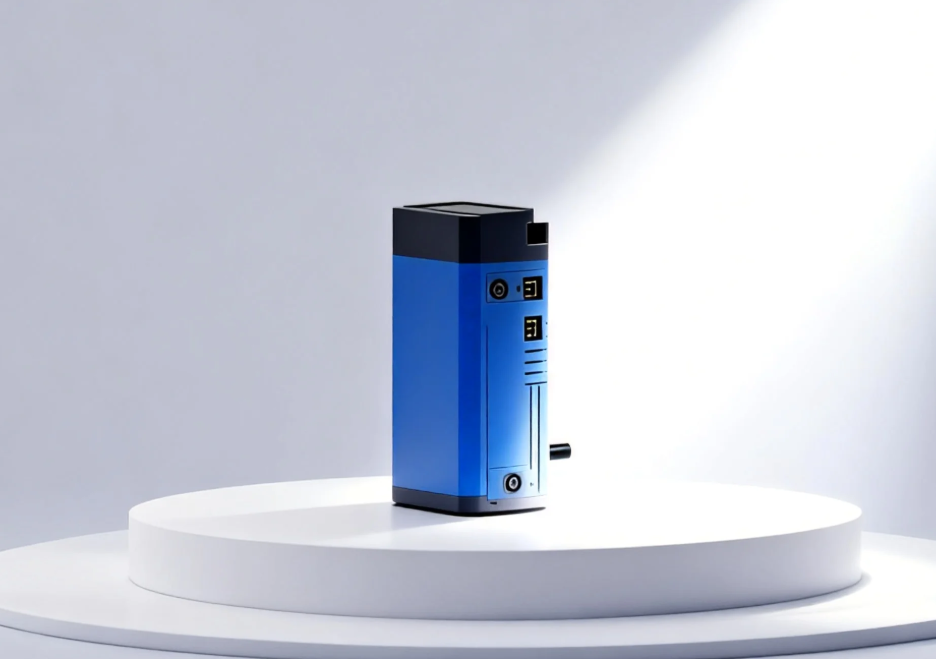
5.5 Control and communication
- For simple machines: digital I/O (open/close, part detected) may be sufficient.
- For advanced cells: use fieldbus or industrial Ethernet interfaces. This gives you full access to position, force and status data.
6. Typical Applications for Electric Grippers
You see the strongest benefits in:
- Electronics and 3C assembly
Handling connectors, PCBs or casings with adjustable force and position. - Battery production and energy storage
Gripping cylindrical, prismatic or pouch cells without deformation. - Lab automation and medical devices
Delicate samples or vials where damage or contamination must be avoided. - Packaging and e-commerce
One programmable robot gripper handles many box sizes and packaging formats. - Collaborative robot workstations
Safe interaction with people, flexible tasks, easy programming and quick changeover.
7. Migration Checklist: From Pneumatic to Electric Clamping
If you are planning an upgrade, use this simple checklist:
- List all current pneumatic gripping tasks and mark those with:
- fragile parts
- frequent changeover
- quality issues
- space for a robot or linear module upgrade
- For the selected stations, calculate:
- required stroke range
- required gripping force
- cycle time and duty cycle
- Choose electric grippers that meet these values and fit mechanically.
- Decide control strategy:
- simple I/O for basic use
- fieldbus integration for robots and advanced debugging
- Design or 3D-print custom fingertips for each product family.
- Introduce recipes in the PLC or robot program so operators can switch products without tools.
- Monitor results: scrap rate, rework, energy use and maintenance time. Use this data to justify further conversions.
8. Conclusion
Electric grippers are more than just “air grippers without air.” Thanks to integrated motors, sensors and controllers, they turn the end of your arm into a smart, programmable clamping axis.
- For basic, robust tasks with minimal variation, pneumatic fingers will continue to serve well.
- For flexible, data-driven automation—especially with robots and collaborative robots—an electric gripper or servo gripper provides better control, safer handling of fragile parts and quicker changeover.
