
A Practical Checklist for Sourcing Linear Modules from China (That Engineers Actually Use)
2025-12-17Linear Modules for PV and Energy Storage Lines: Long Stroke, Dust and Heavy Glass
2025-12-191. 3C Lines Are Not Clean Rooms — They’re “Fine Dust Factories”
From the outside, 3C plants look modern and tidy. Inside the machines, the reality is:
- Flux fumes and fine solder dust
- FR-4 and aluminum chips from routing or trimming
- Label glue, tape fragments, cardboard fibres
- Occasional “creative” cleaning with compressed air
An open module with exposed ball screw and linear guide rail will survive this… for a while. Then you get:
- Abrasive paste on the screw and support bearings
- Increasing friction and torque ripple
- Micro-pitting on the lm guide raceways
- Gradual loss of repeatability
That’s why serious 3C integrators quietly standardize on fully-enclosed ball screw modules as their default linear module for automation in key stations (AOI, laser, assembly).
A fully enclosed linear module puts metal cover strips, seals and wipers between your process dust and the expensive precision parts. You still need lubrication and maintenance — but the interval stretches from “every few weeks” to “planned shutdowns”.
2. Why Ball Screw, Not Just Any Linear Drive?
If 3C is dusty, why not just use belts everywhere and call it a day?
Because 3C products are small, dense, and sensitive. Your axes are doing things like:
- Positioning cameras over tiny pads and fiducials
- Aligning connectors and FPCs before pressing
- Moving screwdrivers and robot grippers into cramped assemblies
- Driving small electric cylinders for precise pressing or testing
That means you care about:
- Micron-level repeatability in short moves
- Stiffness under side loads and torque from tools
- Smooth low-speed motion for vision and dispensing
A ball screw drive in a fully enclosed linear module hits that sweet spot:
- Higher stiffness than most timing belt drive systems
- Predictable backlash (or preload) for precise vision alignment
- Good synergy with servo motor linear module control loops
In some ultra-high-speed applications (e.g. panel AOI), you might compare linear motor vs ball screw. But for the majority of 3C axes, a well-sized ball screw in an enclosed design gives the best balance of performance, cost, and robustness.
👉 If you want a deeper comparison of drive types, this can internally link to一篇选型文:
Related reading: “High Speed or Heavy Load? How to Trade Off When Sizing Linear Modules” on wlbrobot.com.
3. Enclosed Modules Reduce “Invisible” Quality Loss
Here’s the painful part: open axes don’t usually fail with a big crash. They drift.
Common symptoms on 3C lines:
- AOI thresholds slowly tightened to chase unstable images
- Screwdrivers compensating for position errors with longer timeouts
- Fixtures “mysteriously” going out of calibration after every long weekend
Every time an operator tweaks a parameter to calm things down, you’re treating the symptom, not the cause. The root cause is often mechanical:
- Contaminated ball screw → variable friction → variable following error
- Worn lm guide in one zone → tilt when the carriage passes that region
- Loose coupling from repeated overload → inconsistent positioning
By moving to a fully enclosed linear module, you delay all three:
- Cover strips keep debris away from the screw and nut
- Seals and wipers protect the linear guide rail raceways
- Internal cavities keep grease where it belongs, not on your PCB
You still need a decent motion controller and feedback, but the mechanical stack stops fighting you.
4. Enclosed Ball Screw Modules Fit 3C Mechanics and Layouts
3C machines are typically:
- Compact, with stacked stations and an XYZ linear module platform
- Full of cables, hoses, vacuum lines and vision lighting
- Built from multiple small multi-axis linear actuator modules
That’s where enclosed ball screw axes shine:
- Rectangular profiles with internal lm guide rails make it easy to bolt modules into 2-axis gantry stages and 3-axis linear motion systems.
- Integrated motor mounts and support bearings simplify choosing servo motor linear module or stepper motor linear module variants.
- Matching hole patterns let you mix different stroke lengths and load ratings while keeping a consistent mechanical interface.
For example, many 3C lines will use:
- A long-stroke enclosed X axis under the conveyor
- A shorter enclosed Y axis crossing above
- A compact Z with ball screw and brake, holding a robot gripper or tool
This stack becomes a reusable linear module for 3C electronics cell: same footprint, different tooling. You keep engineering costs down and production teams happy.
👉 This是非常适合做站内引导的点:
Related solution: “Multi-Axis Systems with W-ROBOT Linear Modules” on wlbrobot.com.
5. Cleanability and “3C Cleanroom” Reality
Many 3C lines are not true ISO cleanrooms, but they do have:
- ESD requirements
- Regular wipe-downs with alcohol or mild cleaners
- Strict rules against loose particles near optics and open products
An open module is a cleaning nightmare:
- Greased screws and rails trap lint and dust
- Operators are afraid to wipe near moving parts
- Any attempt to “clean” risks washing debris into the bearings
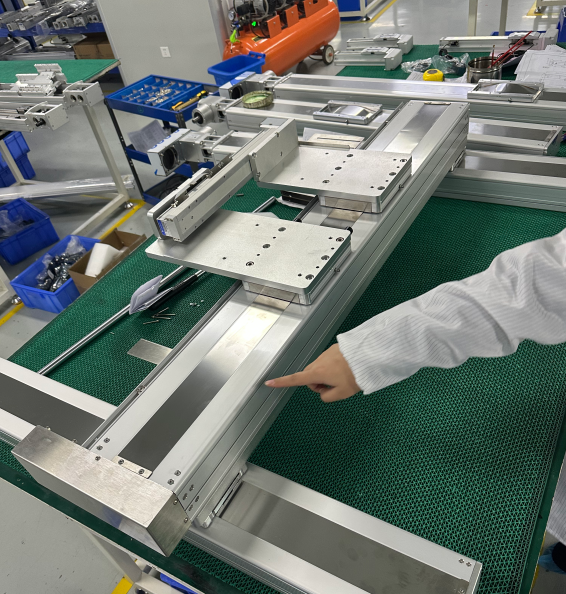
A cleanroom linear module or simply a smooth-bodied fully enclosed linear module is much more maintenance-friendly:
- Flat outer surfaces easy to wipe
- No exposed races or threads
- Lubrication points accessible but protected
For 3C lines that share space with smart devices and cameras, this balance — not fully ISO-rated, but cleaner than a normal machining cell — is exactly where enclosed ball screw modules live.
6. Control and Diagnostics: When Mechanics Help the Software Team
From the control side, enclosed ball screw modules pair well with:
- Integrated motor and driver packages on compact axes
- Centralized motion controller coordinating multiple stations
- Standardized homing and troubleshooting linear actuator routines across the whole line
Because the mechanics are stiffer and more predictable than cheap open rails, you get:
- Shorter tuning cycles for servo loops
- Less variation between axes and machines
- Cleaner data when you monitor current, following error, or vibration
That’s especially important if you’re building families of machines and acting as an OEM: the more consistent each custom linear actuator behaves, the less time you spend firefighting “mystery” issues at customer sites.
7. What to Check When You Source Fully-Enclosed Modules for 3C
If you’re convinced on the concept but still have to choose a linear actuator supplier, here’s a quick checklist:
- Protection details
- Are the cover strips metal or plastic?
- How are seals arranged around the ball screw and lm guide?
- Performance basics
- Load/moment ratings with your real overhangs
- Speed vs stroke length chart for the ball screw
- Recommended servo motor linear module or stepper pairings
- Environment fit
- Grease type and compatibility with your cleaners
- Options for “3C-grade” dustproof linear module vs stricter cleanroom linear module
- Lifecycle
- Maintenance intervals and lubrication methods
- Spare part supply and expected product life
- Realistic linear module price vs uptime and service cost
When you talk to a Chinese linear module factory like W-ROBOT, these are exactly the questions that separate a general-purpose catalog part from a true linear module for 3C electronics.
